Maine Munchies Ad

Friday, August 01, 2008

AdWords Tracking Tip: Use Keyword Insertion in Destination URL

The (Ad)Word of the Day is Keyword Insertion:
Keyword insertion is an advanced feature used to dynamically update your ad text with your chosen keywords. You insert a special modification tag into your ad text to enable this feature for your ads.
The {keyword} tag can also be used in the destination URL to see which actual keyword searches are being triggered by broad matches. For more details, see this answer I gave in an AdWords Help group. Here's an excerpt:
destination URL tracking: ?kw=purple%20flowers
referring search URL: google.com/search?q=pink+flowers

IOW, it's necessary to examine *both* the destination URL and the referring URL in order to understand how broad matches are working. BTW, this example is based on the following AdWords help page:

adwords.google.com/...?answer=68074

I should also point out that if the search query performance report had complete data, there'd be less of a need to track via other means.
For more commentary on that AdWords help page and the way broad match is implemented in the AdWords system, read Purple Flowers Are Not Pink Despite What Google Might Think. Also, those AdWords Help groups are a great resource. Look for my answers (and questions):

AdWords Help

Apogee Tags: , ,

Wednesday, July 16, 2008

Google Domain Parking Class Action Lawsuit

A few weeks ago, I was contacted via email by a law firm in San Francisco saying they were:
... researching AdWords distribution fraud, specifically as it relates to Google's actions relating to their AdSense for Domains and AdSense for Errors programs. Your blog posts have been very helpful in helping to uncover this problem. We are reviewing the possibility of a class action lawsuit against Google, and I would like to discuss this further with you.
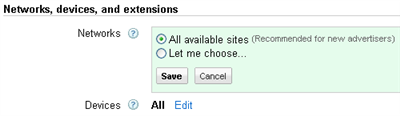
Via Techmeme today, I see they did, indeed, file a class action lawsuit against Google related to domain parking. I had a conference call with a few people from the law firm and explained what I know about Google AdWords and parked domains. After hearing about the particular situation that prompted them to look into the lawsuit, I told them I thought they'd have difficulty with the case. I explained that Google now offers an opt out for the AdSense for Domains program. The problem with the opt out, though, is that most advertisers would not know to find it since it's not a setting in the campaign options. That's where most advertisers would expect to find this kind of option. What's confusing, too, is that the opt out applies to the search network but can only be set from the content network site exclusion tool:

site exclusion tool in google adwords

Anyway, I'm not quite sure what to make of this lawsuit. The particular advertiser in question doesn't seem to have too much data to either prove or disprove fraud. Based on reactions I've seen from other blogs (like Domain Name Wire), I think that advertiser will be portrayed as ignorant. Then again, maybe that's the point - that Google is preying upon small advertisers and, in effect, charging an ignorance tax.

Apogee Tags: , ,

Monday, July 14, 2008

SEO Tool Update: inventory.overture.com Gone

Because Yahoo officially dropped the inventory.overture.com tool, I've stopped linking to it from this SEO tool for keyword research. That SEO tool still sets up links for further research using the free versions of these SEO tools: Wordtracker + Keyword Discovery. Consider this output:

SEO Tool Output

Notice the keyword phrase overture suggestion tool used in both the meta description and meta keywords tags. With the Overture suggestion tool now gone, Keyword Discovery will need to position itself to compete with Google's upgraded keyword tool.

So, what is Yahoo doing now with all of that inventory.overture.com traffic? Let's see:

inventory.overture.com redirect

First, they redirect inventory.overture.com to a searchmarketing.yahoo.com URL.

searchmarketing.yahoo.com redirect

Then, they redirect to a sem.smallbusiness.yahoo.com URL. Eventually, that URL will likely redirect to either adwords.google.com or adcenter.microsoft.com, depending upon this outcome. ;-)

Apogee Tags: , , ,

Saturday, June 28, 2008

Hypocrisy: How Google Profits from Webspam

Any advertiser that uses Google AdWords is unwittingly funding webspam, except for those advertisers that follow step 2 of the 4 Steps to Avoid the Google AdWords Ignorance Tax. Google profits from webspam, at the expense of AdWords advertisers. Follow my logic. Yesterday, Matt Cutts posted about fighting webspam on the Google corporate blog. He said:
Webspam, in case you've never heard of it, is the junk you see in search results when websites successfully cheat their way into higher positions in search results or otherwise violate search engine quality guidelines.
Now, if you follow the link he posted to the Google quality guidelines, it says (emphasis mine):
These quality guidelines cover the most common forms of deceptive or manipulative behavior, but Google may respond negatively to other misleading practices not listed here (e.g. tricking users by registering misspellings of well-known websites).
So, Google's own definition asserts that typosquatting (registering misspellings of well-known websites) is webspam. Guess whose ads run on typosquatting sites? Yes, Google profits from typosquatting sites. So, Google profits from webspam. Here's an example to help illustrate the point (allinz.com is typosquatting on the allianz.com domain):

allinz.com Google ads typosquatting on allianz.com
That's an example I included when writing Vulcan Golf v. Google Trial Will Tarnish Google Brand. See the other 5 examples from that post. I think Google has some explaining to do. Webspam isn't just a problem in the Google search index. No, Google's responsible for the webspam it enables across the AdWords advertising network.

Until Google blocks this kind of search engine spam, it's up to the advertisers themselves to block this traffic.

Related Post (from a year ago):
Is Google NOT Serious About Webspam?

Apogee Tags: , , , , ,

Tuesday, June 24, 2008

SCOR 1 for GOOG - Google Ad Planner Launches Today

Google (GOOG) is launching a new product today called Google Ad Planner. Look at the impact this is having on comScore (SCOR) stock this morning:

scor

I suspect the launch of Google Ad Planner will be a big story on Techmeme today. I've noticed some strong reactions to this new product already:
See the Google Ad Planner Help Center for more details.

Apogee Tags: , , , ,

Saturday, June 14, 2008

4 Steps to Avoid the Google AdWords Ignorance Tax

After writing Automatic Match and the SEM Tax, I thought it would be helpful to explain how to avoid this tax. I like the term ignorance tax, described succinctly via seobook.com:
Yahoo! has the syndication that can't be opted out from, and by default Google opts advertisers into everything. And then there is broad match which might be a bit broad for some advertisers. It seems the networks almost have an "ignorance tax" which hurt many small advertisers who do not know any better.
Since Yahoo will be outsourcing paid search to Google, I'll limit the scope to AdWords only. Whether you're launching a new campaign using Google AdWords or editing an existing one, follow these 4 steps to avoid the ignorance tax:

1) Turn OFF the Content Network
Content advertising has its place but not blended with search advertising campaigns. Keep them separate. For any search advertising campaigns, turn off the content network at the campaign level:

adwords content network off

Now, when you opt out of the content network, ignore any warning Google might issue to try to convince you to remain opted in:

adwords content network warning

2) Block Domain Parking Distribution
To avoid this tax, you'll need to use the site and category exclusion tool. You can't block this traffic via the campaign settings. Follow these directions to block parked domains for search advertising campaigns.

block adwords domain parking

3) Bid by Match Type
To avoid the expanded broad matching tax, adopt a bidding strategy that employs multiple match types.

google adwords keyword match types

4) Turn OFF Automatic Matching
This is a new ignorance tax, currently in beta. If Google automatically opts you in, opt yourself out via the advanced options section when editing campaign settings:

automatic matching

That's it! Follow these 4 steps and you'll save your company a great deal of money. If you found these AdWords tips helpful, pass them on to someone else.

Apogee Tags: , , ,

Friday, June 13, 2008

YHOO + GOOG - MSFT = GOOG

So, Yahoo (YHOO) chose to do a deal with Google (GOOG) and rejected Microsoft (MSFT). Bottom line: Google extends their paid search hegemony. Today, the stock market seems to agree that GOOG is the winner:

GOOG MSFT YHOO

While I don't think a deal with MSFT was a good idea, I'm not convinced that a deal with GOOG is the right move by YHOO. They're clearly throwing in the towel with paid search, despite Yahoo CEO Jerry Yang's statement:
Our strategy to fully realize Yahoo!’s potential is based on the convergence of search and display — the next big opportunity in the rapidly growing online ad industry. This agreement helps us capitalize on that... We’ve done something important today. We are directly addressing one key element in Yahoo!’s strategy to lead the way in search and display. I believe it puts us on a faster track to creating stockholder value and strengthening our advertising leadership.
How on earth does outsourcing paid search to Google help Yahoo lead the way in search and display?! I think they've given up on search and must have something else up their sleeve. I can see an argument that display advertising is their strong suit, but will that remain the case as Google integrates Doubleclick? I still think these 4 strategic alternatives for YHOO should be on the table.

Anyway, I suspect there'll be quite a bit more to say about this new deal. In the meantime, these posts are the best commentary I've seen so far (with widely varying opinions):
Apogee Tags: , ,

Thursday, June 12, 2008

Client in Backpacker Magazine and Saveur Magazine

Saveur Magazine coverI always get a kick out of seeing my search marketing clients mentioned in print. Maine Munchies was recently listed in 2 magazines:
So, take a break and see for yourself why Maine Munchies is garnering some glossy, national attention.

Tags: , , ,

Monday, June 09, 2008

When We Left Earth

when we left earthWhen We Left Earth is a fascinating Discovery Channel documentary about NASA's early manned missions. I became aware of the series after noticing a spike in searches for when we left earth today while checking the TagTrends tool. This is the kind of search that Barack Obama or John McCain might want to target via AdWords (read 3 Secret Tools for Presidential Election Advertising Campaigns for more details on this strategy). People searching for this documentary are likely interested in the space program. If that's the case, they'd probably be interested in the presidential candidates' space policy. So, buying the exact match [when we left earth] would be an ideal way to reach voters with a specific message.

John McCain's site has an issues page about the space program. I didn't find anything about NASA or a space policy on Barack Obama's issues pages. Does he have a space policy? Knowing that a significant number of people are currently searching online for an offline TV show about the space program, now might be a good time to make sure Obama's space policy ideas are elucidated on the BarackObama.com site.

Related Links:
Which Presidential Candidates Have Mastered Google?
discovery.com/nasa

Apogee Tags: , , , , ,

Monday, June 02, 2008

Automatic Match and the SEM Tax

If you advertise with Google AdWords, you'll need to be aware of automatic matching. The Omniture (OMTR) blog includes a recent post - Automatic Match, the Coming SEM Laziness Tax - that includes a clever analogy:
What would you think, though, if I told you that Visa was launching an opt-out feature whereby Visa’s algorithms would look across its customers’ credit card accounts to find customers with unspent credit limits? Visa would then automatically buy products and services for those customers (based on their previous buying habits) with the goal of spending the remainder of the credit?
Read the full post. It's a good one. Then, make sure this checkbox is NOT checked in your Google AdWords campaigns:

automatic match in Google AdWords campaign

Apogee Tags: , , , ,